Wednesday, May 09, 2007

Quick Impressions: Recently Played Games

Review: Here are some quick impressions of games I've been playing in the last few months, with letter grades:

  • Nintendo DS: Metroid Prime Hunters

    About 15 minutes in. Looks and plays just like Metroid Prime on the GameCube. Pretty fun. A-

  • Nintendo GameCube: The Legend of Zelda: Twilight Princess

    About a half hour in. Good graphics considering the platform. So far it seems similar to Ocarina of Time but somewhat more grown-up. Don't like the horse as much as Agro from Shadow of the Colossus; the animations, especially the transitions between animations, are not as good. B+

  • PC: Command and Conquer 3: Tiberium Wars

    Played through the tutorial. Looks like fun. Reminds me of Ground Control. A-

  • PC: Doom3

    Completed on normal difficulty. Okay shooter, outstanding graphics. B

  • PC: Doom3: Resurrection of Evil

    A few hours in. It's much like Doom3; see pretty graphics, enter dark room, things attack from behind and in front, shoot them, continue to next dark room. It's okay but not spectacular. And everything looks just a little too shiny. B

  • PC: Galactic Civilizations

    About five minutes in. Looks and plays much like Galactic Civilizations II, which I got first. Pretty graphics, turn-based gameplay like Civilization or Alpha Centauri but in space, factions, etc. Looks pretty good. B+

  • PC: Rhem

    About 20 minutes in. Disappointed. Was expecting Myst and got something less. Glad it was cheap. D

  • PS2: Burnout 3 Takedown

    Lots of fun. Two words: road rage. The rush when you engage boost mode will scorch your face and blow your eyeballs back into your brain. A

  • PS2: Burnout Revenge

    Fun fun. Two words: traffic checking. The rush when you engage boost mode will scorch your face and blow your eyeballs back into your brain. A

  • PS2: Dragon Quest 8

    Several hours in. Pretty fun. Fairly standard pure turn-based JRPG fare but well-balanced, highly polished, and with a nice Dragonball anime art style that works well with the PS2's graphical limitations. A-

  • PS2: Final Fantasy X

    Around 80% of the way through. Engrossing, entertaining game. Production values are top-notch. The story and characters are well-done, even for a Western audience. Could do without the unskippable cutscenes (and there are a lot of them) and the overly complex levelling and crafting systems. But these are minor drawbacks. B+

  • PS2: Flatout 2

    Fun. Demolition derby is a blast, racing is fun, and ragdoll stunts are a hoot. A-

  • PS2: God of War II

    About 15 minutes in. Looks like more of the same as God of War, and that's a good thing. Greek myth plus outstanding gameplay equals gaming goodness. A

  • PS2: Guitar Hero

    Finished on easy, replaying for perfection. It's a blast. Super fun. A

  • PS2: Guitar Hero II

    Played a bunch of songs in "quick play" mode. It's a blast. Super fun. The addition of practice mode and two-player jamming makes it a bit better than the first. A

  • PS2: James Bond 007: Everything or Nothing

    About an hour in. Fun game. Good cover mechanic. First mission (Egypt) is really hard, even on the easiest difficulty available. It's like being in a Bond movie. Series regulars and Hollywood stars lend their voices and likenesses, including Pierce Brosnan, Judi Dench, John Cleese, Richard Kiel, Shannon Elizabeth, and Willem Dafoe. A

  • PS2: Rogue Galaxy

    A couple of hours in - off the desert planet and into space. It's a pretty standard JRPG, so far. Combat is real-time. A reasonably fun science fantasy. B

  • PS2: Shadow of the Colossus

    Finished once. Replaying to make machinima. This game is a work of art; sublime. Less than a full review cannot do it justice. Play it and see for yourself. A+

  • PS2: Star Trek Encounters

    Completed tutorial and first two or three missions. Not fun. Control scheme is a mess, and the addition of the third dimension is poorly handled. Should have left the three-level third dimension off. D

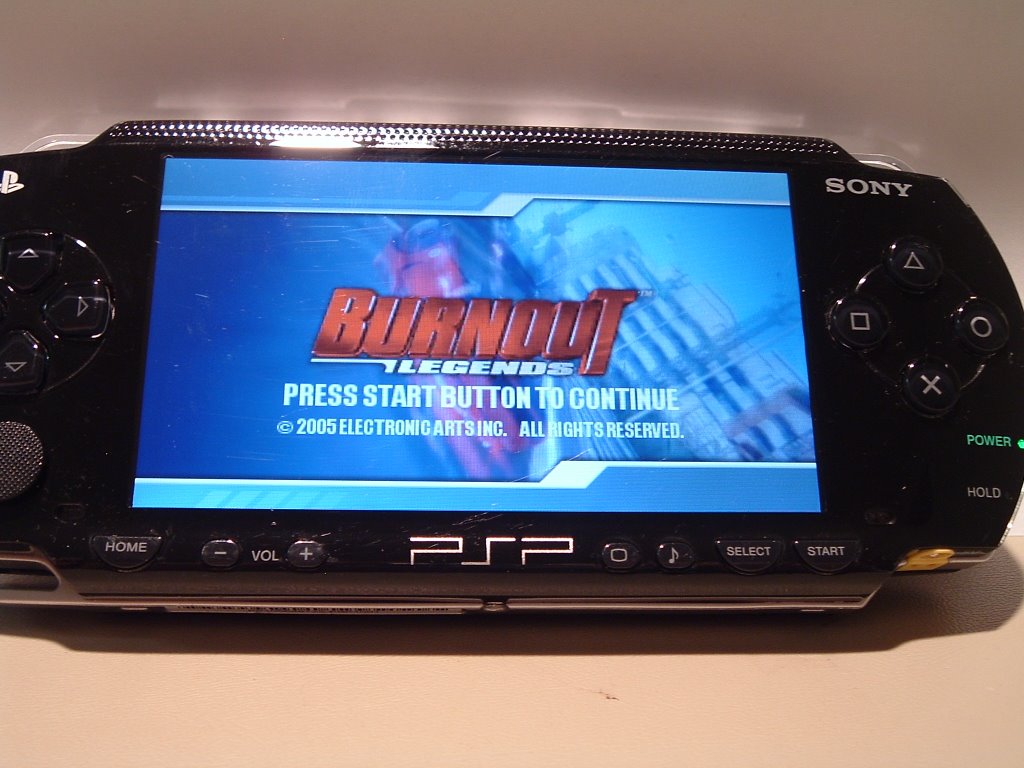
  • PSP: Burnout Legends

    About 15% complete. Looks and plays much like Burnout 3: Takedown. Fun. Minor quibble: where are the car stats? A-

  • PSP: Coded Arms

    An hour or two in. Poor attempt at a first-person shooter. None of the control schemes compensate well for the platform's lack of a second analog input. Something like the scheme in Metroid Prime or Tomb Raider Legend would have worked but they didn't do that. The game is also an object lesson in the pitfalls of randomly-generated content; all the levels seem pretty much the same, lacking tactical interest. Dull. D

  • PSP: Grand Theft Auto: Liberty City Stories

    About an hour in. Fun and funny. Within the limitations of the platform, plays just like GTA3. B+

  • PSP: Killzone Liberation

    About 20 minutes in. Seems okay so far. Interesting game design - isometric view, but still a shooter. B

  • PSP: Me and My Katamari

    Completed first two missions. Pretty fun. Plays much like Katamari Damacy, but the controls don't work as well because of the PSP's lack of a second analog nub. B

  • PSP: Metal Gear Acid 2

    About halfway through. It's okay. Not as fun as the first game, somehow. Same card-based RPG action. Maybe it's the cartoony art style. B

  • PSP: Pinball Hall of Fame: Gottlieb Collection

    Great for pinball fans. Authentic tables. Quick pick-up-and-play. Some platform related limitations. Fun. Don't like having to earn tokens to play Black Hole. Genie is a blast. B+

  • Xbox: Battlestar Galactica

    About an hour in. I've enjoyed it quite a lot, but then I'm a fan of mission-based space fighter games. It follows in the tradition of games like X-Wing, Wing Commander, Freespace, Starlancer, and Star Wars Starfighter. In that tradition, there's no in-mission save, and some of the missions are long and difficult. So it's not for everyone. B+

  • Xbox: Beyond Good and Evil

    Several hours in. It's a fairly enjoyable game. I'm not as fond of it as some of its more vocal fans. I found its mix of children's themes (cartoon talking animals) and adult themes (your protectors in league with your enemies) mildly offputting. Good gameplay though; the ideas are well-executed. C

  • Xbox: Black

    About an hour in. Gameplay is a blast (literally!). Cutscenes are over-the-top silly, too long, and (worst of all) unskippable. B

  • Xbox: Call of Cthulhu: Dark Corners of the Earth

    A few hours in. Creepy. Best chase scene in any game. Best heartbeat vibration effect. Really good story. Voicework pretty good. Slightly subpar graphics but gameplay and story more than make up for it. Very good LOD. A-

  • Xbox: Crimson Skies: High Road to Revenge

    A couple hours in. It's a blast, but then I love flying games. It's fun on Xbox Live as well, but I am not yet worthy to travel in their company. A

  • Xbox: Destroy All Humans

    About four hours in. Fun and funny. Lampoons the politics, popular culture and morés of the U.S.A. of the 1950's. Penalty for dying is having to restart the mission - that is, very little. A-

  • Xbox: Fatal Frame

    About three hours in. Creepy. Scary. Well worth playing. A

  • Xbox: Halo 2

    Finished on Easy, replaying on Legendary. Excellent shooter, though not quite as good as Halo: Combat Evolved. The story is not as coherent. The cliffhanger ending didn't bother me as much as it did some fans. A-

  • Xbox: The Matrix: Path of Neo

    Completed first mission and part of second. Okay so far, controls a little loose. Okay cover mechanic. Not as fun as Enter The Matrix. C+

  • Xbox: Ninja Gaiden Black

    Almost completed first/tutorial level. Lots of fun. The first boss is very hard. A-

  • Xbox: Quantum Redshift

    Just started. This game plays and looks just like the WipEout games for the PlayStation. I love those games, so this is a good thing. B+

  • Xbox: Sphinx and the Cursed Mummy

    About an hour in. Nifty 3rd-person action game. Combines platforming and puzzle-solving with themes from ancient Egyptian mythology. Zelda-like in some ways. Enjoyable. B+

  • Xbox 360: Burnout Revenge

    Fun. Fun. Fun. Two words: traffic checking. The rush when you engage boost mode will melt your face off and blow your eyeballs out the back of your skull. A+

  • Xbox 360: Condemned Criminal Origins

    A few hours in. Seems to be getting a little repetitious. Follow serial killer, beat drug-crazed attackers to death. Rinse, repeat. Environments don't vary too much. Good presentation, solid gameplay. C+

  • Xbox 360: Crackdown

    About a quarter of the way in. Super fun. GTA-style cartoony graphics work well. It's a blast to leap a tall building in a single bound while getting a headshot on a crook, or throwing a dumpster into a crowd of criminals. No real penalty for dying. A-

  • Xbox 360: Dead Rising

    A couple of hours in, sort of. A blast. GTA with zombies and RPG-style leveling. Being able to restart the game while keeping your level is a fun twist. A

  • Xbox 360: Far Cry Instincts Predator

    About an hour in. Pretty fun. Nifty jeep escape sequence. Gorgeous environments. Hard. B+

  • Xbox 360: Gears of War

    Completed story on Casual. This is a fun shooter. No one aspect of the game is a new innovation, but every aspect (except possibly the plot) is best-of-breed. And all the parts mesh seamlessly to create an outstanding gameplay experience. A

  • Xbox 360: Ghost Recon Advanced Warfighter

    Finished first mission. Fantastic looking and playing game. Good cover mechanic. Tons of fun. A

  • Xbox 360: Ghost Recon Advanced Warfighter 2

    Finished tutorial, started first mission. Seems much like the first, with some minor graphical and gameplay improvements. Challenging and fun. Good game. A

  • Xbox 360: Need for Speed: Most Wanted

    About a third of the way through. This game is fun. I enjoy the GTA-like open city aspect. The graphics are very good, the cars are slick and the tuning aspect is well done. Races are fun and evading the cops is even more fun. B+

  • Xbox 360: Oblivion

    Main quest completed, now playing the expansion and mods. Beautiful. Engrossing. Immersive. Addictive. Entertaining. Fun. Play. This. Game. A

  • Xbox 360: Perfect Dark Zero

    Completed first storyline mission (nightclub). Fair shooter. Good cover mechanic. B

  • Xbox 360: Pinball FX

    Okay pinball simulator. Tables invented for the game, none taken from real life. B-

Shadow of the Colossus: Machinima May Be Cheap But It Ain't Easy

I've been working on a machinima movie version of Shadow of the Colossus. I did some work on it last year, then put it aside. Now I've started shooting again, and am reminded of how difficult some aspects of making a movie like this are.

I'm going to tell you what the hardest part of making this movie is, starting with the other parts that weren't quite as hard.

It wasn't finding an affordable capture device. The WinFast TV USB II Deluxe does a quite adequate job of capturing SD content, at a reasonable price.

It wasn't finding an affordable editing solution. Between VirtualDubMod, AviSynth, and the wealth of filters available for both, capturing, cutting and processing the footage is reasonable if not easy.

It wasn't finding an affordable solution for authoring a high-quality DVD (my target medium). TheFilmMachine allowed me to use encoding bitrates above the limits set by consumer products like those from Sonic or ULead, and between IfoEdit and DVDPatcher I was able to properly mark my video as 16:9 anamorphic widescreen so that all players would handle it properly (something the consumer DVD-authoring products won't do reliably).

It wasn't beating each colossus gracefully and quickly in a single camera shot, a restriction I'm limited to because the music can't be turned off or down.

It wasn't even trying to play the game and manage the camera at the same time, or doing trick camera shots to eliminate the main character from a shot.

No, what is hard is trying to get on the thrice-damned horse! I'd been trying to get the second colossus in a single shot, and made more than twenty attempts before giving up. Sometimes I made Wander tiptoe when he should have run, other times I made mistakes when attacking the colossus, and so on. But the vast majority of the shot-killers were when I tried to get Wander to mount the horse, and instead he ended up leaping through the air next to it. Even with the jump-and-grab trick, I miss the horse more than half the time. It looks ridiculous.

So now I'm going to shoot each colossus in segments, and make sure than any necessary horse-mounting comes at the beginning of a shot. That way, if I muff it, I can immediately retry rather than re-shoot the several minutes that come before it.

Wanted: An Overlay Filesystem for Windows

One of the biggest advantages of game consoles over PCs is ease of use. Consider all that's often required to play a game for the first time on a PC:

  • Before buying check to make sure your PC meets the minimum requirements for the game.
  • Make sure your hardware drivers are all up to date (or out of date if newer drivers have problems with that particular game).
  • Defrag your hard drive.
  • Install the game.
  • Find and install any patches so that the game has a chance of working without glitchiness
  • Tweak all the game settings for your hardware, carefully balancing video, audio and gameplay quality against framerate.
  • Make sure the game CD is in the drive.
  • Play.
Compare this to what's usually required to play a game for a console:
  • Make sure the game is for your console.
  • Make sure you have a memory device for your game saves.
  • Put the game in the console.
  • Play.
Even on subsequent plays, the PC suffers in usability because upgrades to hardware, drivers or other software can render a game unrunnable. And the game will always take up a significant amount of space (several gigabytes for recent titles) on the hard drive.

If you have a hundred console games, you might need a few memory cards, but that's all. But if you have a hundred PC games, you're going to need a hard drive with 200 gigabytes or more of free space to install them. Or you're going to have to give up the ability to choose which game to play on a whim, and instead carefully choose which games you leave installed.

It doesn't have to be that way. Well, the hardware variation issue isn't going to be solved any time soon. But there isn't any reason why games should have to be installed and consume large amounts of hard drive space. There are some existing games that only store saves, configuration information and patches on the hard drive. Some of those don't even require installation. Here are a few titles I own that (can) leave their content on the CD-ROM:

  • Tomb Raider (#2 - #5)
  • Wing Commander 3
  • Some titles in the Myst series
  • Atari Anniversary Edition

Microsoft's ''Games for Windows" initiative is meant to deal with exactly this problem by making PC games run the same way that console ones do. Halo 2 for Windows Vista will not require installation but will load from the DVD just like its console cousin. This is terrific, but it only helps with new games. What about your existing library?

That's where an overlay file system comes in. Conceptually, it's like a transparency laid over a sheet of paper. When you first read it, what you see is the text on the underlying paper. But anything you write goes on the transparency, and when you next read it, what you see is mostly the underlying text except where it's obscured by the new writing.

With such a filesystem, one could:

  • Install the game
  • Burn a DVD-ROM with the contents of the installation folder
  • Delete the contents of the installation folder
  • Make the installation folder the transparency over the DVD-ROM drive
After this, attempts to read from the game installation folder would be redirected to the dvd if the file isn't found there. And attempts to write to the installation folder (for instance, for save games or configuration data) would go there and overlay the old versions residing on the DVD-ROM.

So the game would play off the DVD-ROM, while configuration data and saves would go on the hard drive. The only drawback would be the decreased file reading speed.

There is such a filesystem already for Linux called unionfs (and a newer less buggy version called aufs). It's how the Knoppix distro of Linux runs from DVD while keeping user data on the hard drive.

Now if we Windows users could just get a little of that love... :)

Gran Turismo 4's Useless Strategy Guide

When I buy a strategy guide, I have certain expectations. First I look for the lists. There should be lists of items in the game, lists of unlocks and their conditions, and lists of various statistics. Then I seek out the tips and tricks - advice on how to play the game better, legitimate play strategies for beating enemies or accumulating in-game goodies. Next there should be cheats, including such things as in-game backdoor codes, cheat device codes, and game glitch exploits. Finally the guide should include one or more walkthroughs, step-by-step instructions on how to get from the beginning of the game to the end.

By these standards, Prima's guide for Gran Turismo 4 falls short. It's got plenty of lists and statistics, but its gameplay advice provides little more than does the in-game text, and nary a cheat nor a walkthrough is to be found. In the case of cheats it can be argued that there really aren't any for Gran Turismo 4, and anyway one wouldn't expect to find them in an official game guide. Gameplay advice and walkthroughs are a different matter.

I suppose that it was a wise decision for Prima not to sell the book as a strategy guide, for there is precious little of that in it. As I mentioned, the gameplay advice is pretty much what can be found in the game itself. There is no walkthrough of any kind. Sadly, I was able to find more and better advice for free on the Internet than in this $17 book.

I took that free knowledge and did a little research of my own. I replayed GT4 from the beginning and took notes. You can find the results here in my blog article, The Lazy Gamer's Guide to Gran Turismo 4.

A final note: If anyone is wondering whether the official guide for Gran Turismo 3: A-Spec is any better, well, it isn't. In fact, the two guides are so similar that they look like they were authored by the same people, despite being from different publishers.

My Halo Heresy: Bungie's Mistakes

On the Halo Story Page and in the Halo forums the participants can be seen dissecting every piece of minutia that comes from Bungie. Posters derive long chains of reasoning and speculation from the tiniest details of the games, books, the graphic novel, and interviews with Bungie employees - the material considered canonical. Here I commit sacrilege:

  • Bungie makes mistakes.
  • Story continuity is not Bungie's primary concern.
Evidence follows.

Here are nine items, each of which supports one or the other of the two claims above. Each can with sufficient effort be explained away, but not without straining the bounds of credulity. In each case a more likely explanation is the one I propose.

  1. Continuity: No Brutes or Drones in Halo: Combat Evolved

    The Brutes and Drones are nowhere to be found in Halo, but are common in Halo 2, which occurs only a month later. There have been attempts to explain this away, but none seem very likely. Let's examine these:

    • The Brutes and Drones have only recently joined the Covenant, and have only just begun to be deployed on Covenant vessels.

      I'd have an easier time believing this if there were only a very few of them in evidence in Halo 2. But they're already more common than Hunters.

    • Brutes and Drones were not previously trusted enough to serve on Covenant ships.

      If that were true, that isn't the sort of thing that happens all at once. Trust takes a generation or more for a new subject race to earn. But even that doesn't make sense; in any empire built on subjugation -- as the Covenant is -- the first thing that a new member of the empire gets to do is to serve as cannon fodder.

    • The ages-long feud between the Elites and the Brutes precludes them serving on the same ship, in the same fleet, or even in the same chain of command.

      ...which is flatly contradicted by events in Halo 2; Elites and Brutes worked together (at the mining platform and on Delta Halo) until the Prophet of Regret was killed. And even if this were the case, it doesn't explain the absence in Halo of the Drones.

    • There just didn't happen to be any Brutes or Drones in the portion of the Covenant fleet that went to Halo.

      Coincidence? Now there's a likely explanation. In which case you'd need to also explain why they didn't appear in The Fall of Reach, which is supposed to be consistent with the "Halo Bible".

    No, the most likely explanation is the one that's outside the story. The game developers wanted to give the player new enemies to fight. So they invented a couple and then did their best to backfit them into the storyline, with limited success. The reason that the story bits presented for the Brutes don't seem to fit with the events seen in Halo is that they don't. They're not so much explanations as rationalizations.

    In the beginning of the "Et Tu, Brute" video documentary a Bungie developer comments that the Brutes were introduced too late in the development of Halo 2 and were not well thought out. This suggests that the Brutes, maybe the Drones, and possibly the entire Covenant civil war, were not in the Halo Bible prior to the development of Halo 2.

    In the universe of Halo: Combat Evolved, Brutes and Drones simply didn't exist.

  2. Continuity: Brute Changes for Halo 3

    The video documentary on Brutes introduced us to new behaviors, uniforms, and group tactics for Brute warriors. The absence of these in Halo 2 poses the same problem that the absence of Brutes did in Halo: Combat Evolved. The same arguments and counter-arguments apply.

  3. Mistake: Covenant knowledge of Earth

    By the end of First Strike, it's clear that the Covenant knows that the location of the human homeworld is Earth. Yet in Halo 2, only six ships show up, and it becomes clear from their radio chatter that they came to Earth expecting to find something, but not humanity.

    What appears to have actually happened is that Halo 2 was originally meant to be the conclusion of the story. Bungie made a mistake in the development process and as a result had to reduce the scope of the story, cutting the last three chapters, moving that part of the story to a third game, and also moving the main invasion of Earth there.

    Bungie's development mistake is an idea supported by interviews with Halo 2 devs in which they admitted spending so much time producing the new game engine that they were left short of time for content and polish.

  4. Mistake: Cortana's First Insertion into Master Chief's Armor

    In The Fall of Reach, which takes place before the events of Halo: Combat Evolved, Cortana is inserted into Master Chief's armor during its testing. Yet at the beginning of the game when she is inserted for the second time, both she and Master Chief react as though it's a new experience.

    "Hmm," she says, "Your architecture isn't much different from the Autumn's." "Don't get any funny ideas," he responds. Her comment makes it clear that she's encountering his suit's computing architecture for the first time, and his indicates that this is the first time he's discussed her potential control of the suit with her.

  5. Continuity: Johnson's "Special Moment"

    Upon completing Halo: Combat Evolved at Legendary difficulty, the player is treated to a special cutscene. Sergeant Johnson and an Elite are wrestling over an assault rifle when they notice that the Pillar of Autumn is about to explode. They stop wrestling, Johnson says, "This is it, baby. Hold me," and they hug(!).

    This scene breaks continuity any way you look at it. I realize it's meant to be a joke, and it is funny, but that's the point; continuity is not Bungie's primary concern. They'll sacrifice it to improve gameplay (Brutes and Drones) or even to make a joke.

  6. Mistake: Johnson's Flood Immunity

    After publication of First Strike, Bungie discovered that the explanation for Johnson's immunity to Flood infection was problematic for their long-term plans for the storyline. So they added a story to The Halo Graphic Novel which presented a contradictory account of Johnson's escape from the flood, and a page of documents, one of which suggests that the prior explanation was a hoax perpetrated on Dr. Halsey by the Office of Naval Intelligence.

    The problem is that even with the fig leaf of an explanation at the back of the graphic novel, the story in it (Breaking Quarantine) still contradicts the account in First Strike. While ONI could have falsified Johnson's service record (and would do so were he a Spartan-I and they wanted to conceal that), what they could not do is falsify the results of Halsey's own tests. She investigated his immunity and found that he had a neurological disorder that prevented Flood from infecting him. How he got the disorder is irrelevant; it's incompatible with the graphic novel's story in which he escaped by means of massive badassery.

    So Bungie made a mistake in allowing an account inconsistent with their overall storyline to make it to publication, and then made another mistake in trying to fix it.

  7. Mistake: Knowing Halo's Name

    No one on the player's side is aware that the ringworld is named Halo until Captain Keyes reveals it on being rescued from the brig of the Truth and Reconciliation. It's clear that it's new information to Cortana, as the first thing she does with it is to search Covenant radio chatter for references to it, which she would have done already had she known its name.

    However, on the Pillar of Autumn's bridge, in the first cutscene of the game, there is a diagram on the main computer display that's clearly labeled "Halo".

  8. Mistake: Cortana's Subspace Remark

    In the first scene of Halo: Combat Evolved, Cortana tells Captain Keyes, "No one could have missed the hole we tore in subspace." That is the first, last, and only reference to "subspace" in the entire Halo corpus. Everywhere else it's called "slipspace". Perhaps Jan Taylor was channeling Star Trek for a moment?

  9. Mistake: Halo's Destruction

    It may have been dramatic for a piece of Halo next to the Autumn's explosion to fly across the ring and smash through the other side, but it was wrong. The Autumn was lodged against the inner surface of the ring, and that factor combined with the ring's rotation would have caused any ring fragments to fly outward.

    Then there's the ring's rigidity. No object of that size is going to show the kind of stiffness shown in the explosion sequence. Even if it were made of scrith the ring would bend and flex like a rubber band when disrupted.

There are more examples to be had, but these are enough to support my thesis.

So I say to all the Halo theorists out there, lighten up! Don't overthink every detail and nuance of the Halo corpus looking for hidden meanings, like some lit-crit professor run amuck (if that isn't redundant). You'll get the answers soon enough, when Halo 3 comes out.

Monday, March 12, 2007

All-Time Picks and Pans Moved to GeoCities

I've deleted my posts listing all-time picks and pans for various platforms. The lists will continue to evolve, so I've decided to move them all to my home pages on GeoCities. Here's the link: All-Time Videogame Picks and Pans

Sunday, December 03, 2006

The Lazy Gamer's Guide to Gran Turismo 4

Before I begin the tips for playing GT4, I'd like to pass along three items of general advice:

  1. GT4 saves your screen aspect ratio to your memory card but not your screen resolution. So if you want to play at 480p or 1080i, you'll need to set that every time you start the game.
  2. Play GT4 in 480i or 1080i. 480p looks awful.
  3. Get a Logitech Driving Force Pro wheel. You won't be sorry.

If you think that the fun part of driving and racing games is driving fast and exotic cars in races against other fast and exotic cars, if you think that cone challenges and hot laps and pace laps are just the chores you have to get through to get to the good stuff, then this article is for you.

Here's how to play GT4 so you maximize the amount of time you spend racing fast cars and minimize the amount of time you spend earning the money you need to buy them:

First, get your B and A licenses. Yeah, I know, it's a chore, but it's less of one than getting to the same place by trying to race without licenses and earning money in dribs and drabs. Plus, you'll need those licenses later in order to race more interesting courses against more challenging opponents. For that matter, you'll need the IB, IA and S licenses in order to run all the races in the game, so resign yourself to working through them. Don't worry about golding the licenses; bronze will get you what you need.

Now, go to Used Car Showroom I and buy a Honda Civic SiR-II (EG) '92. The '91 will probably serve just as well; it's the same price and has the same specifications. Give your Civic an oil change to boost its HP, then add the following modifications:

  • Racing Chip
  • Exhaust and Air Filter: Semi Racing
This should be enough for the next step.

Using your modified Civic or the car you got for your A license, go to the Beginner arena and win the Sunday Cup a couple of times. The second time run it in B-Spec mode, unless you enjoy these races. To win races in B-Spec mode, start the race at speed 5, passing mode and maximum time acceleration. As soon as your car is in front, turn off passing mode and drop back to speed 3. Keep the first car you win (an Autobianchi A112 Abarth '79) for your collection, and sell the second one for the roughly 8,000 CR it's worth. Take this money and add the following modifications to your Civic:

  • Flywheel: Racing
  • Turbine: Stage 2
  • Weight Reduction: Stage 1
This will improve the performance to the point that the car can now win at least the first race in the next step.

Go to Honda under Japan, and enter the Civic championship under One-Make Races. With each race you win or almost win, use the money to improve your Civic's performance so it can win the next race. Again, use B-Spec mode to cut down on the boredom of running the same race over and over. Here are the modifications to apply, in the order they should be applied:

  • Clutch: Sports
  • Brakes: Racing
  • Sports Tires: Soft
  • Weight Reduction: Stage 2
  • Clutch: Triple Plate
Winning this championship will get you a MUGEN MOTUL CIVIC Si Race Car '87, which unmodified is good enough to do the next step.

Get in your new Civic race car, and go to the Special Conditions arena. There, enter the second series. This is the Capri Rally at Costa di Amalfi. You can easily win this race with this car. Keep the Toyota RSC Rally Raid Car '02 you get for winning this series, and use it to win a second time. Sell the second Rally Raid Car for 265,624 CR. Rinse and repeat until you have at least 441,250 CR.

Go to Mercedes-Benz under Germany and buy an SL65 AMG (R230) '04. Give it an oil change, then take it to the tuning shop and add these modifications:

  • Exhaust & Air Filter: Racing
  • Racing Brakes
  • Brake Controller
  • Port Polish
  • Engine Balancing
  • Racing Chip
  • Nitrous
  • Transmission: Full Customize
  • Clutch: Triple-plate
  • Flywheel: Racing
  • Limited Slip: Full Customize
  • Carbon Driveshaft
  • Turbine Kit: Stage 4
  • Intercooler: Racing
  • Suspension: Full Customize
  • Racing Tires: Hard
  • Weight Reduction: Stage 1
  • Weight Reduction: Stage 2
  • Weight Reduction: Stage 3
  • Increase Rigidity
  • Rigidity Refresher Plan
Enter it in the one-make series Legends of the Silver Arrow. For winning you'll get a Mercedes-Benz CLK Touring Car '00.

Give your new CLK Touring Car an oil change and add these mods:

  • Exhaust & Air Filter: Racing
  • Brake Controller
  • NA Tuning: Stage 3
  • Nitrous
  • Transmission: Full Customize
  • Limited Slip: Full Customize
  • Turbine Kit: Stage 4
  • Suspension: Full Customize
  • Racing Tires: Medium
  • Increase Rigidity
  • Rigidity Refresher Plan
Go to the European Events arena and enter the car in the Deutsche Touring Car Meisterschaft series. The first time you win, keep the AMG Mercedes CLK-GTR Race Car for your collection. After that you can sell succeeding prizes from this series for 743,749 CR. That should be enough cash flow to buy even the most expensive cars in the game.

Remember to play the Deutsche Touring Car Meisterschaft series in B-Spec mode, to speed up your cash flow. Also, you can skip the first race in the series and still win, speeding up your cash flow even more. Yes, you'll lose the money you'd have won from that first race, but that's more than made up for by how much faster you pull in the prize cars.

And that's it! When it comes to in-game money, you're now on Easy Street. Go race.

Norton Ghost Exorcised

There was a time when Peter Norton's programs were the best system tools available for the PC. However, in recent years, mostly since the acquisition by Symantec, the quality appears to have been slipping.

  • Norton Antivirus has a significant negative impact on system performance.
  • Norton SpeedDisk made my system unusably slow for the entire week I left it running, with no indication that it would ever finish 'optimizing' my hard drive.
  • Norton Protected Recycle Bin didn't really add any significant functionality to the Windows Recycle Bin, and like the other apps was a resource hog.
  • Norton GoBack is another resource hog, adds little to Windows System Restore, and by many accounts makes systems unstable or even renders them unbootable. Hardly acceptable behavior for a program that's supposed to protect you from buggy software that screws up your system.

Norton Ghost has now joined the growing list of Symantec products I would never voluntarily install.

I was getting ready to upgrade to a larger hard drive, and wanted to simply move my entire filesystem to the new disk, along with all my installed games and game saves. A drive imaging program would do the trick. I happened to have a copy of Norton Ghost 2003 I'd gotten with a hard drive, and I'd heard good things about it, so I decided to try that.

I installed Ghost, ran it, and found that it wanted to boot in its own "virtual partition" so it could copy files that are locked while Windows is running. Fine. So I let it do its thing and rebooted the PC. On reboot Ghost told me something was wrong and offered to let me reboot the machine in its previous state (i.e. before Ghost twiddled the partitions). So I chose that, rebooted, and it...

Displayed the same error message.

After several hours and an rapidly increasing percentage of gray hairs, I was able to find a combination of commands issued from the Windows XP Home install disk and from a Linux boot disk (Knoppix 4.01) that allowed me to fix the partitions and drive letters back and delete Ghost's virtual partition. To my great relief, on the next reboot I was back in my familiar Windows XP environment.

After uninstalling Ghost and removing from my system any trace of it I could find, I did some research. I dug into the nooks and crannies of the Web, and it appears that Ghost has problems with SATA boot drives, which is the kind I have. But that's really beside the point.

What we have here is a backup tool: a program to assist you in securing your data against mishap. But it modifies the source before copying it, and does so in a way that renders the machine unusable if anything goes wrong. Sure, I was able to restore the machine to its previous state. But I'm also a computer professional with over twenty years of experience. Joe Normal who doesn't know the tricks I do would be sunk; he'd either have to find someone like me to help him or reformat his drive and lose everything.

So I now renounce all software Symantec. There would have to be some indication that their software development methods have had a major change for the better before I considered purchasing or using any of their products.

Epilogue: I found a combination of Linux tools that would let me do the image copy, and which was considerably faster than solutions based on reading the filesystem file by file. And I can now use it to make regular backups of my system drive.

Tuesday, November 28, 2006

ActionReplay Max PS2: Mind the Sharp End

ActionReplay Max for the PS2 can be useful for backing up your game saves, but it also contains gotchas that can destroy them as well. Here's a quick guide to the gotchas and how to work around them.

Failure to Read While Restoring: Sometimes the MaxMemory software will report an error while trying to copy (or uncompress) a game save from the ActionReplay flash drive to a standard PS2 memory card. In fact, it will sometimes happen multiple times on a single save file. This may give you the idea that the save is corrupt on the flash drive. Fear not! Often ActionReplay has trouble reading its own flash drive. Retry the operation several times, and reset the PS2 at least once and try several more times, before giving up. One of my saves refused to be copied five or six times before finally succeeding.

Failure to Write While Restoring: Sometimes the MaxMemory software will corrupt the data on the standard PS2 memory card it's writing to, resulting in a partially or wholly unusable memory card. The PS2 browser cannot be used to reformat the card. The only way to recover use of the card is to reformat it using the MaxMemory software. Once reformatted, it can be used again, but all of the saves that were on the card are gone. I strongly recommend restoring saves only to a memory card that has nothing else on it.

Incompatible With Other ActionReplay Hardware: The ActionReplay MaxMemory software can neither read from nor write to the ActionReplay MaxMemory 64MB memory card. It only works with standard 8MB memory cards and the 64MB USB flash drive that comes with the MaxMemory software.

Making Unsafe Saves Safer

If you've ever worried about losing your Xbox, Xbox 360 or PS2 game saves (to an accident, mistake, hardware failure or small child), then you may have tried to make backups of your saves, only to find that you can't copy some of them. In this article I'll describe the problem, guess at the reasons for it, present some advice for game makers, and finally pass on what workarounds I know of to make backups of these 'uncopyable' game saves.

The Problem

A few months after I bought an Xbox and a PS2, I realized I had hours of progress on some games that I'd be unhappy about losing.

So I set out to save my saves. I have purchased memory cards for all my systems to backup saves onto, and tried to copy my saves to the cards.

The first system I had trouble with was the Xbox. Ordinarily when a save is selected, the Xbox dashboard offers options to copy or delete. But on some of my games, only the delete option was offered. Some web research revealed that Microsoft offers developers the ability to mark saves so that the dashboard won't copy them.

What the-???!!!

Out of my library of 79 Xbox titles, 15 have save games that are uncopyable either explicitly, or practically (Fatal Frame's saves are five times the size of an Xbox memory card). That's about one out of five. The titles from my collection with the problem are:

  • Black
  • Burnout 2: Point of Impact
  • Burnout 3: Takedown
  • Call of Cthulhu: Dark Corners of the Earth
  • Darkwatch
  • Driver 3
  • Fatal Frame
  • Fatal Frame II: Crimson Butterfly: Director's Cut
  • FlatOut
  • Forza Motorsport
  • Half-Life 2
  • Jade Empire Limited Edition
  • Psychonauts
  • Silent Hill 4: The Room
  • Star Wars Knights of the Old Republic II The Sith Lords

I checked my PS2 saves, and there was a property on each save called "file protection" that made me nervous. Just this year I picked up two titles that turned out to have uncopyable saves:

  • TOCA Race Driver 2
  • TOCA Race Driver 3
Sure enough, the 'file protection' save property was on. So Sony offers the same kind of game save copy protection to developers that Microsoft does. It seems to get used far less often, though; only those two out of the 28 PS2 titles I've tested have uncopyable saves.

Just recently I started backing up my Xbox 360 saves, and two out of the 10 titles I own won't allow copying of save files:

  • Perfect Dark Zero
  • Gears of War

The Reasons

After the surprise and outrage over not being able to copy some of my game saves subsided, I began to see the reasons why a console maker might offer such a thing, and why game publishers might use it. The purpose is not, despite how it may appear, to prevent players from using their saves on a friend's system, nor to make players restart their games from scratch in the event of a hard drive or memory card failure. Those are just side effects.

Nor is the intent to stop the hardcore hackers, those who are willing to modify the console hardware to get what they want. With hardware mods all bets are off. Legal tactics are the method of choice for suppressing hardware mods.

No, the intent of the manufacturer, the game publishers, and the game developers is to stop casual activities they don't want. I think there are four main reasons why some game saves are uncopyable: online cheating, piracy, homebrew, and offline cheating.

Online Cheating: The idea here is that a game that gets a reputation as a playground for cheaters will sell less. This also applies to games which are single-player only but which have online leaderboards. The easiest way to cheat online is with a hacked gamesave. The cheater transfers the save to a PC, applies a hacking tool, and transfers it back. Some forms of cheating don't even require a hack; if a game stores online progress in offline saves, then merely having a backup of a save is a kind of cheating. Wins can be copied to the backup, while losses can be erased by restoring from it. Making game saves uncopyable closes this particular avenue for cheating, though of course it still leaves open hardware mods and net hacks (and does nothing to stop save hacking on systems where there's no built-in hard drive).

Piracy: This affects the manufacturer's bottom line as well as the publisher's, as the manufacturer gets a percentage of game sales revenue. Not every pirated copy of a game represents a lost sale, but some number of copies do. In order to reduce the amount of this going on, the manufacturers have taken steps to prevent burned copies of games from running on the console. These include [a] Microsoft using a DVD-ROM drive that has trouble reading writable media (or in more recent hardware revisions, is deliberately configured to reject DVD-Rs), [b] Microsoft using an unusual disk format that can't be read by PC DVD readers, [c] Microsoft writing into the disk loading program a check to see if the game disk has been cryptographically signed by Microsoft, and [d] Sony writing their loader to check the disk media type to make sure it's a commercially pressed game disk rather than a burned copy.

One of the more convenient ways pirates use to get DVD-R copies of games to run is hacked saves. Some games contain bugs that can be exploited to make part of a game save's data executed as code, thus enabling the pirate to run a game loader that doesn't check for the cryptographic signature or media code. Making the game saves uncopyable closes this opening for casual pirates, at least on the Xbox where the only way to get the save onto a PC is to first get it off the Xbox hard drive and onto a memory card. Serious pirates can still use hardware mods in order to play their downloads, but this requires skill and money, thus greatly reducing the number of people playing burned copies.

Homebrew: Many game consoles are sold at a loss. This is true in particular of the P52, the Xbox, and the Xbox 360, at least for the first year or two after their introduction. The way the manufacturer makes money is through licensing fees on games. In return for the licensing fee (and other conditions such as certification), Microsoft adds the cryptographic signature that will allow the game to run on the console, and both console makers press the disks on commercial media. If people could easily make games run on the console without the cryptographic signature or correct media code, then there'd be no reason for anyone to pay the licensing fee. Then instead of losing money on the console and making it back on the games, the console manufacturers would just be losing money. Not only that, but the quality of games would be completely uncontrolled and there could be a repeat of the Atari 2600 fiasco from the 80s. Not an attractive proposition.

As mentioned before, the easy way to get unsigned code and burned disks to run is to exploit a game bug with a hacked save. Again, not being able to copy saves for that game closes that loophole (on the Xbox). Hardware modders can still run homebrew games, but that's a tiny fraction of the financial exposure that would come from everyone being able to run unlicensed games.

Offline Cheating: I don't see a financial reason to stop cheats in offline games, so I'm going to chalk this one up to pure anal-retentiveness. I know for sure that there are developers who wish to force a particular game experience on the player. For instance, in the case of Call of Cthulhu: Dark Corners of the Earth, the developers had the option to create a save-anywhere feature, but--quite deliberately--chose to have savepoints instead, so that the player could not (for instance) choose to save during a frightening and deadly action scene. The designers wanted the player to feel the fear of having to do the entire scene over again, in addition to fearing the things trying to kill the player's character.

With this sort of high-handed attitude, the player must experience the form of enjoyment intended by the game designer and no other. Given that, I can understand if not approve of attempts to stop single-player offline cheating. Even something as simple as loading an earlier (backed-up) save in order to get out of the corner the player has painted himself into, rather than having to start the game over from the beginning, can circumvent the designer's intended experience. And cheating via hacked saves? That completely demolishes it. Making the saves uncopyable prevents debasement of the designer's work by the casual cheater.

Or I could give the benefit of the doubt and suppose that the saves are actually uncopyable in order to prevent online cheating, piracy hacks and homebrew hacks.

So... With all these reasons why console manufacturers and game makers would want uncopyable Xbox saves, why are any saves copyable at all? I think it's due to a combination of factors, including a lack of anal-retentiveness, an evaluation that the losses stopped by preventing game save backups are less than the losses created by angering customers, and having other less onerous methods of achieving the same results. It's telling, I think, that Microsoft thought these problems serious enough that they deliberately removed from the Xbox 360 a function to copy Xbox saves for backward compatible games, and also prevented those saves, once created on the 360, from being copied onto memory cards. That's right; no original Xbox game saves can be copied from the Xbox 360 hard drive onto a memory card.

Some of these copy/no copy decisions, however, appear to defy logic, leaving the above explanations in doubt. For instance, take Burnout 3: Takedown. The saves on the PS2 version can be freely copied, but the ones on the Xbox are locked. Yet the saves for Burnout: Revenge can be copied on both platforms. One could argue that the problems with copyable saves on Burnout 3 were fixed with Revenge, and that there's not much point in protecting saves on the PS2 as it has no internal hard drive. But then there's TOCA Race Driver 3, which has saves copyable on the Xbox but not on the PS2! Try to make sense of that one.

Advice for Game Makers

Though using game save copy protection may stop abuses like casual softmodding for piracy or homebrew, and casual savehacking for online or offline cheating, it also stops legitimate players from from safeguarding their progress. Game makers may come to the conclusion that hindering the abuses is worth more to them than the goodwill of their legitimate customers, but what if they didn't have to choose one or the other? What if there were ways to stop the abuses without angering the customers?

Let's go through the reasons mentioned above for uncopyable saves, and see if there aren't other solutions. I will begin by stipulating that these other solutions are ineffective against modchips and other hardware hacks; but then, so are 'uncopyable' saves.

Online Cheating: If all online progress is stored on the server rather than the console, then online cheating by hacking the save becomes impossible, as the player doesnt have an offline save to hack. Some material, such as downloaded multiplayer expansion maps, has to be stored on the console, as broadband comnections are not yet fast enough to make on-demand maps practical. However, this kind of static content can incorporate cryptographic signatures that are validated at load time, making savehacked maps useless.

But what about games that use offline single-player progress to unlock online bonuses, or that keep online leaderboards of single-player achievements? The first of these is a bad idea for game design reasons, and both can be handled by a fairly simple technique.

With the exception of co-op story mode, multiplayer and single-player modes in games tend to be very different experiences. In fact, they're usually different enough to be like completely separate games, appealing to players with opposite tastes and skills. Single-player content draws those who prefer to be told a story and progress through the content to its end, beating the game, while multiplayer draws those who want pick-up-and-play action where they're competing against or teaming with other people. Skills that are necessary to dominate one mode are often useless in the other. Even players who enjoy both kinds of experience tend to play them as separate games; I know I do.

Worlds apart as the two play modes are, it doesn't make sense to tie progress in one to the other; most multiplayer enthusiasts I've heard from are uninterested in single-player game modes. Requiring single-player progress in order to unlock multiplayer bonuses makes a game a chore rather than fun. If there's going to be online multiplayer progress, it should be tied to online multiplayer achievements.

That said, if the game designer is going to insist on tyeing mutliplayer features to single-player achievement, or if an online leaderboard of single-player scores is wanted, then the way to do it is to provide a separate online single-player mode. Such a mode would be playable only online, with all save data being stored on the server. This eliminates savehack cheating, so that the save data on the console can be freely copied.

Piracty and Homebrew: The solution to this one is basic software quality control. Treat save data as input and validate it before using it. Array bounds checking, offset range validation, and other input verification techniques are basic tools for safe programming, as are automated unit tests that check for such vulnerabilities. If buffers can't overflow, then executable code can't be altered to give an attacker access.

Offline Cheating: Oh come on. This isn't a problem that needs solving. Really. In fact, leaving this vulnerability open may increase sales and will certainly increase the game's enjoyability for those with lesser skills.

Workarounds

For original Xbox games, the only workaround I can offer is for the one game that prevents copying to memory card by being too big: Fatal Frame. For the others, nothing short of running Xbox Linux or an alternative dashboard will give the ability to copy the protected saves. And both of those require a modchip or (for older machines not connected to Xbox Live) a savehack. Here's the workaround for Fatal Frame:

  • Get an Xbox USB adapter. This is a device that plugs into a controller port and provides a USB socket.
  • Get a USB flash drive that's compatible with the Xbox and big enough to hold the save (64MB or larger). You can find lists of these drives by searching the Web. I use a Lexar Jumpdrive Secure 128MB.
  • Plug the flash drive into the adapter, the adapter into a controller port, and format the drive.
  • Copy your Fatal Frame save to the flash drive.

For PS2 and Xbox 360 games, the general strategy for backing up saves is this:

  • Start the game with the original memory device inserted, as well as the backup.
  • Load the save from the original device.
  • Remove the original memory device.
  • Switch the game's save location to the backup device.
  • Make the game save itself to the backup device (usually by tweaking some game setting, then tweaking it back).
The reason for removing the first memory device is because some games will attempt to delete the old save when you change which memory device you're using.

The above strategy will work for both TOCA Race Driver 2 and TOCA Race Driver 3 on the PS2. You can drop the removal step, as neither game tries to delete the old save.

For the Xbox 360 game Perfect Dark Zero, the above strategy works when the original save is on a memory card. Just drop the settings change step, as the game saves itself the moment you change the save location. But when the original save is on the hard drive, a variation on the technique is necessary, as I think it unwise to remove the hard drive while the console is running! To copy your save from the hard drive to a memory card, do this:

  • Insert the memory card.
  • Start the game and proceed to the main menu.
  • Change the save location to the memory card.
  • Remove the memory card.
  • Change the save location to the hard drive.

For the Xbox 360 game Gears of War the above strategy will not work, and a different technique is necessary. A Gears save cannot be copied to an empty memory device; the 360 complains that it can't copy the save to a new profile. However, an existing save tied to the same profile can be overwritten. So:

  • Start the game with both memory devices inserted.
  • Change the save location to the backup memory device.
  • Start a new single-player game.
  • Skip cutscenes as much as possible and play until the first checkpoint is passed.
  • Quit the game.
  • Exit to the dashboard.
  • Copy the game save from the original device to the backup device, overwriting the save just created.
  • After this, the save can be copied from the original device to the backup device without a problem.

Tuesday, November 21, 2006

Xbox 360 - Gears of War - First Impressions

Nearly two weeks ago I picked up several new games, including Gears of War. I tried it first, and since then I've had to force myself to sample the others. It's that good.

No single aspect of this science fictional third-person shooter is novel, but each is state-of-the-art, integrated into a cohesive whole, and polished until it shines. It's a joy to play.

So far, I grade it A.

Enough scribbling, I've got aliens to frag.

Tuesday, October 17, 2006

Levelling the Playing Field: Mice And Analog Sticks in First-Person Shooters

During a game of SOCOM 2, player Red One catches sight of Blue One. Blue has his back to Red, so Red decides to try for a headshot. Red aims at Blue, but the crosshair stops to the left of him. So he tugs the analog stick up and right. But he overshoots, so he tugs left. Overshoots again, and tugs right. Tugs left. Right. Left. Down and right. While all of this is going on, Blue notices Red's presence, turns, and tosses a grenade. The grenade goes off, and Red is dead.

Before the next match, Red reduces his control sensitivity so he can aim precisely and get a headshot next time on Blue.

Red creeps along a wall, past a closed door, peeks around the corner, and there's Blue. Red aims and gets a headshot on Blue. But then he hears the door open behind him. He tries to turn but with the decreased control sensitivity it takes a long time. Long enough for Blue One's teammate Blue Two to kill Red.

Frustrating, isn't it?

Had it been a PC shooter such as Counter-Strike, the mouse would have given Red the precision control to get the headshot as well as the turning speed to deal with a threat from behind.

This is why people who have played PC shooters tend to prefer them to shooters on the consoles.

Console shooter designers are faced with a dilemma: if they make the input ramp steep enough to provide quick turning when the stick is pushed over all the way, then the turning speed rises too quickly near the stick's dead zone for precision aiming. But if they make the ramp shallow enough to provide slow turning in the area near the dead zone, then it is still too slow when the stick is pushed over all the way.

A number of solutions to the problem have been tried, with varying degrees of success. Many involve eliminating to one degree or another the need for precision aiming. These include:

  • Aiming assistance - either the crosshair or the shots will drift towards the target when the player's aim is close enough
  • Target lock
  • Target lock with fine tuning
  • Large hitboxes around targets
  • Inaccurate automatic weapons with high rates of fire
  • Large blast radius for explosive weapons
  • Enemies who aim or react slowly and aim inaccurately
  • Translating the position of the analog stick, within a certain range, into the position of the aiming crosshair. Outside that range, stick position is translated into turning speed.
  • Accelerating turning speed with time - the longer the stick is held in one position, the faster the turning speed becomes.
In addition to these solutions, many shooters pass the dilemma on to the player by giving him an input sensitivity control. Not that I think having such a control is bad; it's just not a way to fix the problem at hand.

The above, by the way, is one reason that console and PC versions of the same shooter cannot play on the same server; every solution above, if applied equally to both PC and console, continues to leave the advantage in the hands of the PC user. If applied to one but not the other, it results in battlefields that are incompatible and can't run on the same server.

There is a solution, however, that I believe can level the playing field and even give console players a slight edge over the keyboard-and-mouse crowd:

Input Acceleration

I first encountered this when playing Half-Life on a laptop PC. It wasn't always practical to use a mouse when I wanted to play, so I began experimenting with the TrackPoint device. For those of you not familiar with it, the TrackPoint is a tiny pressure-sensitive joystick that sits between G and H on a laptop keyboard and is meant to substitute for the mouse. The harder you push it, the faster it moves the pointer across the screen.

Most people don't like TrackPoint devices because of the difficulty in controlling them: on low sensitivity they can get accuracy but not speed, and on high sensitivity they can get speed but not accuracy. Sound familiar?

This is where input acceleration comes in. With input acceleration turned on, a gentle to moderate push results in slow pointer movement for pixel-perfect accuracy, while a medium to hard push sends the pointer zipping across the screen. When applied to Half-Life, this permitted precision aiming with a gentle push and quick turning with a hard push.

Without input acceleration, doubling the pressure doublea the speed, tripling the pressure triples the speed, and so on. With input acceleration, doubling the pressure might give four times the speed, tripling it might give nine times, and so on.

If input acceleration were applied to an analog stick as to the TrackPoint in my laptop, this would give console gamers the speed and accuracy they need in order to compete with mouse-and-keyboard users.

In fact, it should give them a slight edge. Using the left stick for running and strafing is superior to using the keyboard, because it allows the player to more precisely control movement speed. And having all the buttons within finger's reach means a quicker response than when they're scattered over a keyboard.

So if input acceleration is so good, why isn't it in use? Well, it could be that some console shooters do use this method to make aiming easier, and I either haven't played them or I haven't noticed. That would then make the question why it's not used more.

I suspect the three major factors are ignorance, inertia, and haste. Some developers are ignorant of the possibility of using the technique, so it isn't even considered. For others, there's inertia; it's easier to do what's already been done than to invent something new. For many of the existing solutions, there may even be code available that can be lifted and reused. Finally, there's haste. Software development tends to be on tight schedules, never more so than when the project is a port from a PC shooter. When deadlines are tight, the risk to the ship date from using a known solution is far less than using something new.

On the other hand, analog sticks have a travel and are operated by the thumb, while TrackPoint sticks don't move and are operated by the more dexterous index finger. It could be that developers have tried it, and the differences between analog sticks and pressure sticks mean that input acceleration doesn't work nearly as well for consoles as for notebooks. In which case I, and this entire article, are full of it. Wouldn't be the first time.

Saturday, September 16, 2006

UMD Repair - Less Is More

WEASEL WORDS OF WARNING: The procedure described below is entirely at your own risk. It has worked for me, but that is no guarantee that it will do so for you. Damage or destruction of your UMD or PSP is not my responsibility.

That said, I don't see how, if you follow my instructions competently, you could do any such damage. But fools are surprisingly innovative in their foolishness.

UMD shells are not rugged. Store too many UMDs in a space too small for them, such as the outside pocket of a PSP carrying case, and you're likely to find some of them damaged.

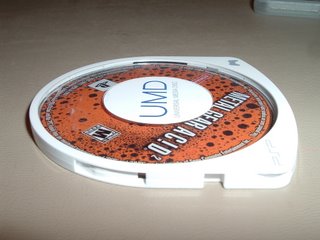
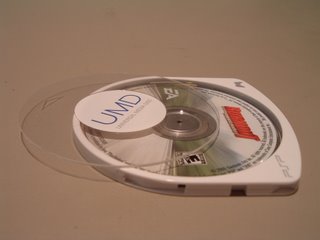
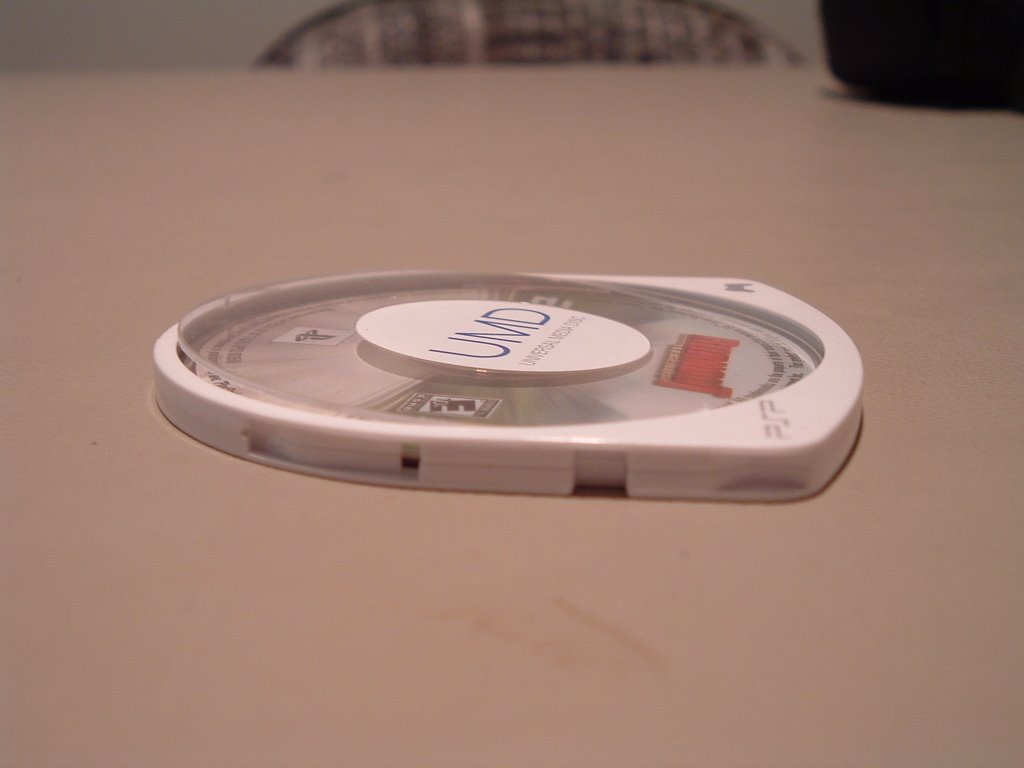
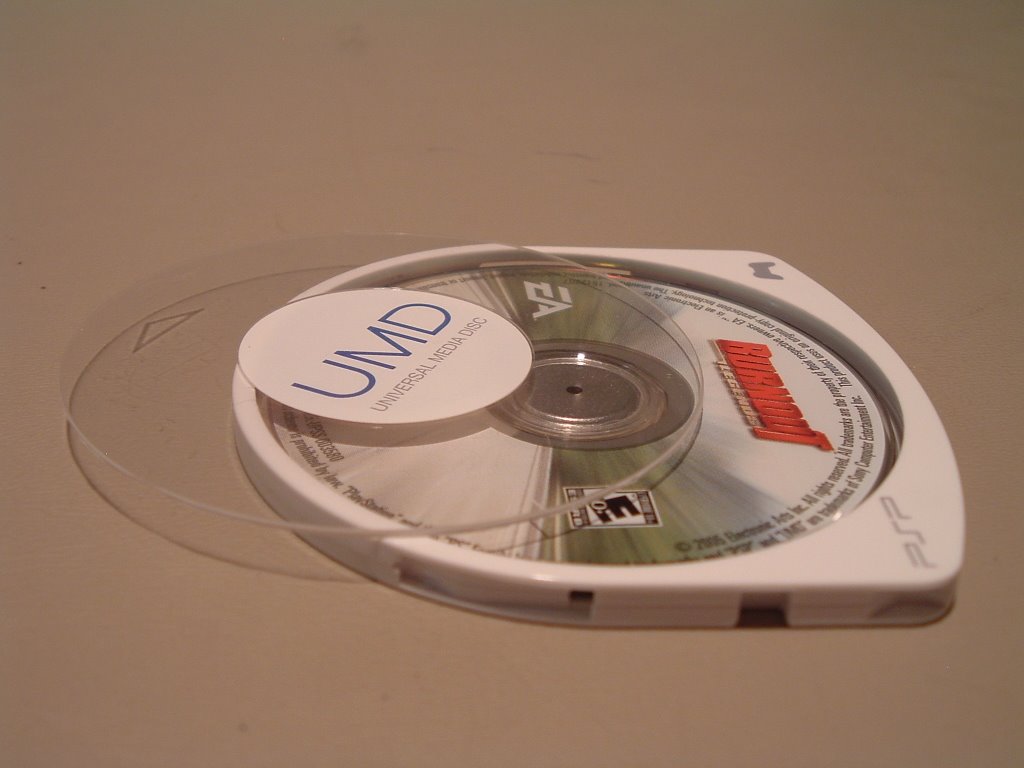
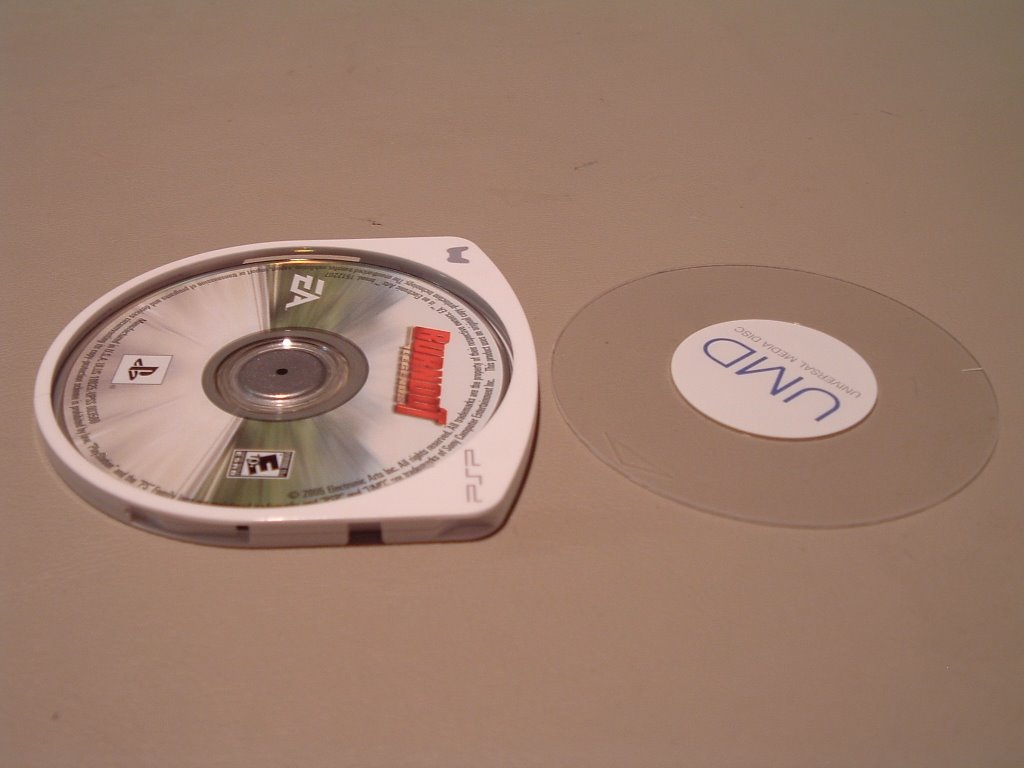
An undamaged UMD

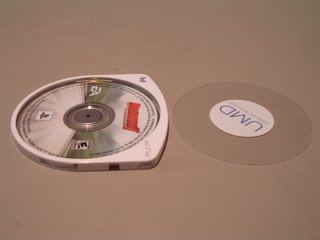
The most common damage type I found was separation of the window, which then falls into the interior of the shell. When the UMD is inserted into a PSP, the window jams against the data disk and keeps it from spinning.

A UMD with window separation

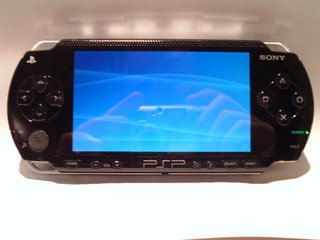
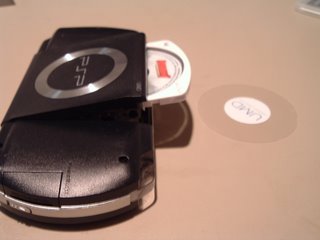
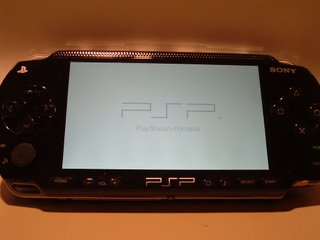
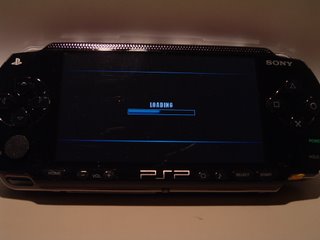
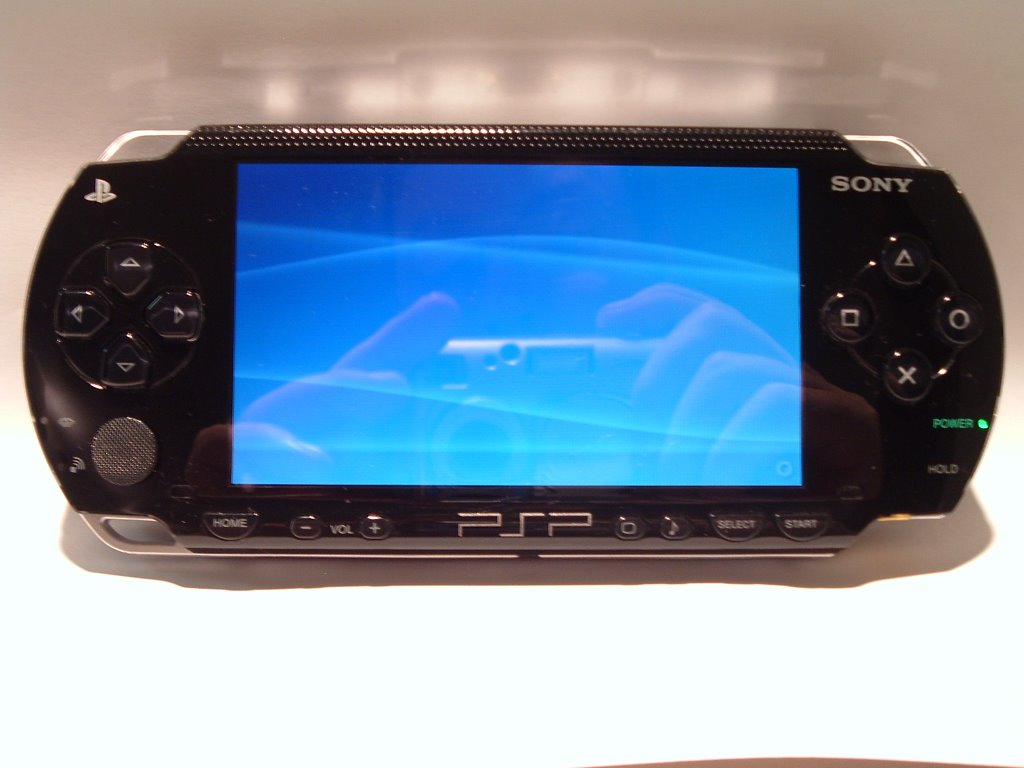
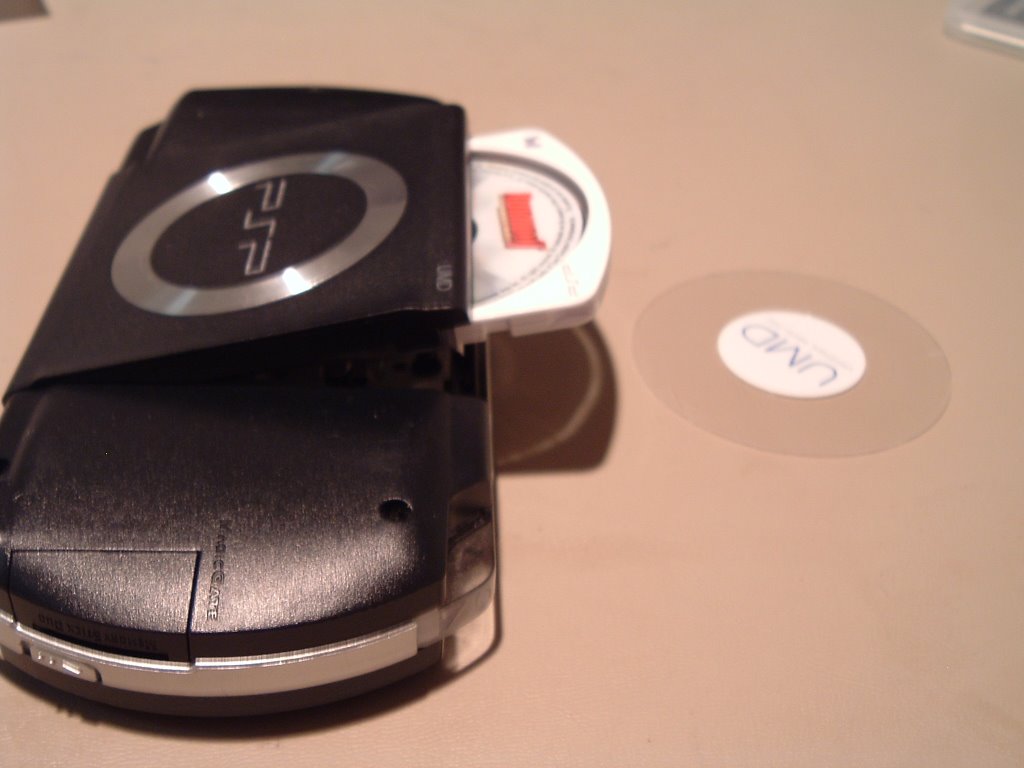
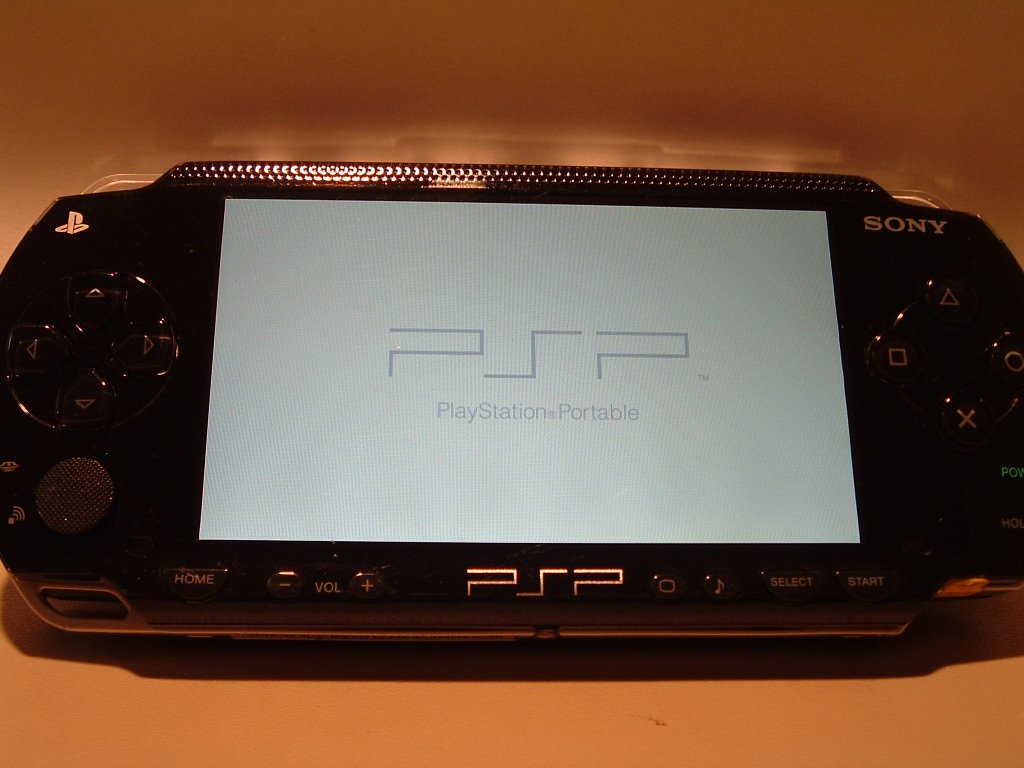
PSP not booting from damaged UMD

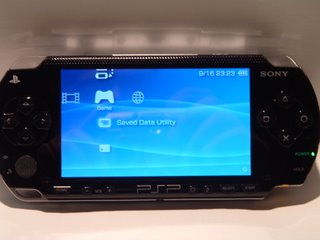
PSP not loading damaged UMD

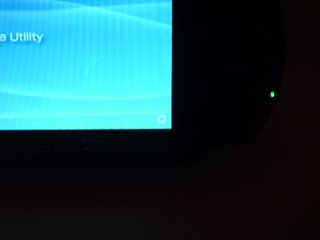
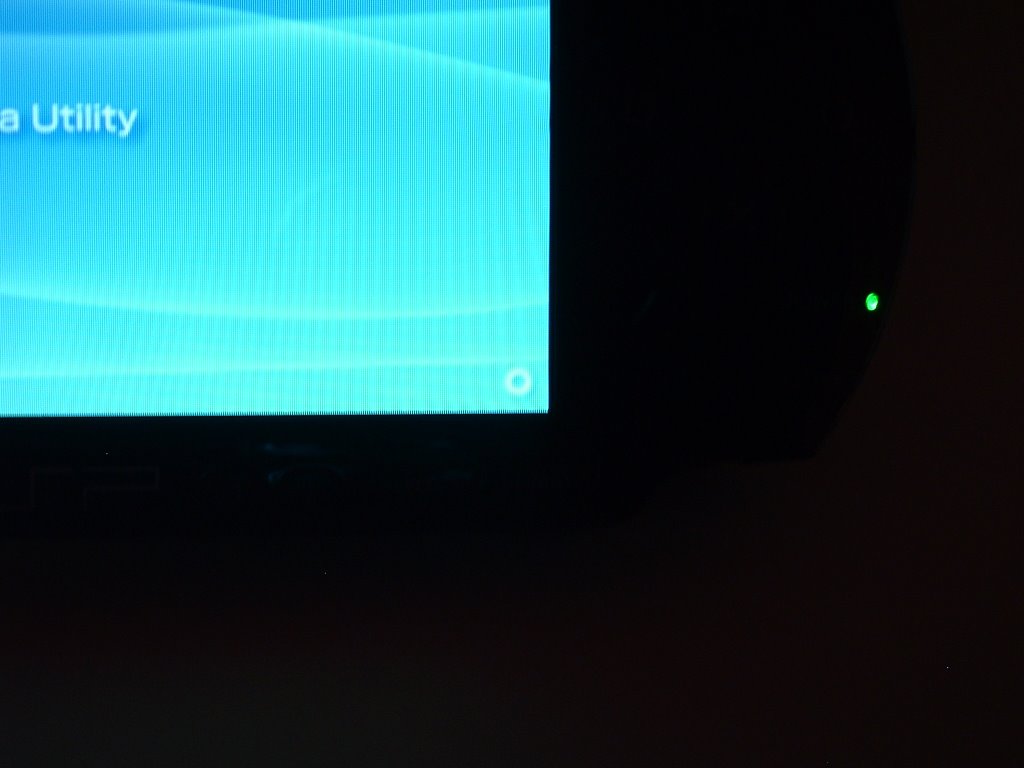
Close-up on trying-to-load icon


I have spent a lot of time tryng to re-seat or partially re-seat the window, and searching the web for a source of UMD replacement shells. The first is an exercise in frustration, and Sony prevents the second. Apparently their position is that cracked UMDs are prima facie evidence of piracy, so they neither make replacements nor license the patents.

Then I had an idea inspired by a YouTube video. It worked beautifully. Here's my workaround:

That's it!

Monday, September 11, 2006

My Grading System

In my post on my reviewing system, I mentioned that I'd be giving various aspects of games letter grades with specific meanings, but failed to mention those specifics. Here they are:

Grading Scale

A+
Incredible.
A
Outstanding.
A-
Excellent.
B+
Very Good.
B
Good.
B-
Significantly better than average.
C+
Better than average.
C
Fair.
C-
Worse than average.
D+
Significantly worse than average.
D
Bad.
D-
Really bad.
F
Awful.

Further UPS Yours

When I called Microsoft on Tuesday August 29th, I was delighted to hear that my repaired Xbox 360 console had already been shipped. This meant that I would have it back by Friday, in time for the three-day Labor Day weekend. I got the tracking number, and checked the UPS site to see where the package was. Sure enough, it was on its way.

On Thursday evening, the tracking information showed that the package had arrived at the Phoenix distribution center. So surely I would have it the next day, right on schedule.

Or not.

I checked the tracking log a few times during the day Friday, but there were no updates. This wasn't that unusual; sometimes the out-for-delivery scan wouldn't happen, and the next item in the log would be the delivery. And the delivery attempt could be as late as 7PM (officially; on the previous shipment, I saw a couple of attempts around 7:30). So I went home at 5PM and called UPS.

I wanted to know if the package was at the UPS distribution facility. If it was, I could go down and pick it up, even after 6PM by going to the Will Call window. The customer service representative had no more information than what was in the tracking log, but promised I would get a call back within an hour from the distribution center to let me know where my package was.

An hour came and went, and there was no call. I waited until 7PM, then called UPS again. This time I was told it was too late for me to pick it up, even from Will Call, so I would have to wait until Tuesday for a delivery attempt. Sigh.

Having resigned myself to not having my toy until after the weekend, I asked them to hold it for me. I said I would come and pick it up Tuesday morning. I didn't want a repeat of the previous fiasco where it took a week and five alleged delivery attempts to get me my package. The customer service rep said that would be fine. Around 8 I got a call from the distribution center, asking me if it was correct that I wanted the package held. I said yes.

During the weekend, I saw in the tracking log that the package had been missed at the distribution center, and was scheduled for delivery the next business day. This gave me pause. Hadn't I asked them to hold it? But since the distribution center had called me back to make sure I wanted the package held, surely this time they'd hold it for me and it would be there when I went to pick it up on Tuesday.

Or not.

After fighting through traffic for 45 minutes on Tuesday morning, and waiting in line for 20 minutes behind other people who thought they'd beat the rush by showing up early, I got to the counter and asked for my package. Only to be told that it was on a truck that had already left.

Feeling much like Charlie Brown having once again fallen for Lucy Van Pelt's promise not to yank away the football at the last minute, I drove to work.

I checked the tracking log a couple more times during the day, and found that my parcel had been (finally) delivered to the apartment leasing office in the early afternoon. Surely it would be there when I got home from work.

And it was.

So UPS, at least here in Phoenix, is a delivery company that sometimes holds packages when it's supposed to deliver them, and sometimes delivers them when it's supposed to hold them.

So what can Brown do for me? I will leave that as an exercise for the reader, but here are some hints: it involves my posterior, and osculation.

Thursday, September 07, 2006

PlayStation 2 (PS2) - Killzone Review - Single Player Complete (as Templar)

Platform: PlayStation 2
Publisher: Sony Computer Entertainment America
Release Date: 11/02/2004
Game Type: First Person Shooter
Genres: Science Fiction, Military
Single Player Modes: Story, Skirmish
Multiplayer Modes: Console, Online
ESRB Rating: M (Blood, Strong Language, Violence)
Current Price (used): $15 USD (GameStop.com)
Grade: B

General Comments

When Killzone was in development, it was hailed as the "Halo Killer", the title PS2 fanboys were waiting for, the game that would prove once and for all that anything the Xbox could do, the PS2 could do as well or better. But anyone with even a casual knowledge of the technology differences between the two platforms knew that this claim could only be marketing uber-hype. And so it was.

The problem with over-hyping a product is that it creates expectations that cannot be satisfied. It short-sightedly trades a spike in pre-review sales for a slump in post-review profit, as the reviews will reflect those disappointed expectations. And only the most rabid of fanboys will buy solely on the strength of the publisher's pre-release hype.

The reviews did reflect that disappointment, with the average score on GameRankings.com coming in at a disappointing 72.3% ("C-" grade), compared to Halo's 95.8% ("A"). Similar discrepancies are seen in the units-shipped figures, with Halo coming in at over six million and Killzone less than two. Some will say that the financial figures don't reflect the true popularity of each title, as Halo's been out for more than twice as long, and for a long time it came bundled with every new Xbox. Which would be a more convincing argument if it weren't for the fact that Halo 2 came out around the same time as Killzone, and has already sold more than five million copies.

So, which is correct, the reviews or the hype? Is Killzone better than Halo and worth buying a PS2 to play, or is it a yawn-inducing, barely pasable shooter? The truth is somewhere in the middle.

Game Description And Initial Impressions

Killzone is about the invasion of the planet Vekta by gas-mask-wearing Helghast troops. The planet Helghan became home to a group of people exiled from the rest of insterstellar society, who have since built a mighty war machine and are now exacting revenge on their perceived oppressors by conquering them. Vekta has the misfortune of being Helghan's nearest neighbor, and therefore the first target in the campaign against the ISA.

If this all sounds familiar, it should; the backstory closely parallels the historical events surrounding the start of World War II. This makes Helghan the equivalent of Nazi Germany, and Vekta a future version of Poland.

The single-player game puts me in the combat boots of Jan Templar, a captain in the ISA Defense Forces, and later provides the chance to play as any of the members of his four-man squad. Each of the four has unique strengths; Templar is the all-around soldier who can use any weapon. Luger is an assassin who gets a fully automatic sniper pistol and night-vision goggles. Rico is the heavy-weapons specialist who carries a chaingun. Hakka is a half-Helghast spy who can get better accuracy with Helghast weapons and can operate Helghast equipment. The goal is first to get the planet's hacked orbital defenses back online, and later...well, that would be telling.

After a cutscene summarizing Helghast history and showing the first moments of the invasion of Vekta, the game presents the main menu. After choosing the single-player campaign, there is a brief cutscene that sets up the tactical situation. Then I am thrown into combat, attempting (as Captain Templar) to repel the Helghast assault on a Vektan city.

When I first started playing the campaign, I got a sinking feeling in my gut. I began having flashbacks to Medal of Honor: Rising Sun and its rail-shooter sequences. The game opens with Templar and other soldiers in a trench, with a mass of Helghast troops rushing their position. I, as Templar, must stay in a fixed position and shoot down enemies before they can reach the trench. This is followed by movement to a new trench and more defensive fire. Much of the first mission follows this pattern.

Now, I have nothing against shooting galleries or rail shooters per se. I'm sure they're a lot of fun for the people with the twitch reflexes to succeed at them. I'm just not one of them. In fact, I don't think I ever was one of them. But when I buy a first-person shooter, I have a certain expectation that there will be movement and tactics, use of cover and concealment, perhaps even a flanking maneuver. Rail shooters and shooting galleries offer none of these. They are unwelcome in my first-person shooter, except in very small portions. Less is more. If I want The House of the Dead or Beachhead 2000, I know where to find them. And when such scenes do appear in my FPS, they should be a welcome respite from more difficult portions, offering overwhelming firepower with which to mow down great swaths of enemies while laughing maniacally.

And so I put Killzone away for a long time, turning to more rewarding (or so I thought) games. When I did return to the single player game, it was only to practice for online multiplayer with a distant friend.

I quickly discovered that the shooting galleries of the first mission are not ubiquitous. Gameplay after the first mission is more about attacking enemy forces and driving through them than it is about repelling their assaults. My interest began to revive, and I played it almost exclusively until I finished it.

Presentation

Story

I found the storyline to be good, but not outstanding; it's a fairly standard war story, which is not surprising considering the situation is a thinly-disguised version of World War II. The characters all have distinct personalities and their own backstories, and conflicts between the members of my squad make for some watchable cutscenes. The dialogue is (mostly) well-written, and there are some memorable lines. On the other hand, there are plot holes big enough to drop an asteroid through, and the villain's ending speech is so bad that it's obvious the actor was embarrassed to deliver it.

Graphics

The graphics are pretty good, and look like they're pushing the limits of the PS2's technology. Unfortunately, "pushing the limits" also means that frame rates sometimes suffer. Widescreen is available but not 480p. Polys and textures seem pretty high on the people, and medium elsewhere. I'd say the models and textures for the characters are comparable to the best in other PS2 games, including Silent Hill 2 and Shadow of the Colossus. Draw distance is limited, and there's a little bit of popup to be seen here and there, but nothing too distracting. What is noticeable are the occasional seams visible between some of the polygons for the environment. Still, it wasn't so bad that it interfered with my enjoyment of the game. And once an APC turret briefly appeared to be ten times its normal size, though that only lasted for a moment. Animation is good, with most character movement looking pretty natural. The sole exception I noticed was when a killed soldier would do the "ragdoll jitterbug" as it failed to find rest in death. But that comes with almost any game that uses ragdolls. Weapon animations, especially reloading, are outstanding and easily on a par with anything I've seen elsewhere. Animation of vehicles and other environmental objects is of equal quality. Physics is cheated into the game using scripted animations and particles; a system like Havok just isn't feasible within the limitations of the PS2. But the cheats are pretty good. Notably enjoyable ones are windows shattering, water cooler bottles exploding and bouncing around, tank turrets blasted into the air, and guard towers collapsing.

Art Direction

Art direction is very good bordering on excellent, doing a fine job of giving a gritty, war-torn feel to all the areas. Buildings, vehicles, scenery and people look quite realistic. The only oddity I found in this area was the lack of contrast. Everything is in muted shades of white, grey, blue, brown and green, with hardly a saturated color to be found anywhere. The most colorful thing in the game is the yellow-orange glow emanating from the Helghast soldiers' goggles. This muted color scheme works well when the environment is a series of trenches reminiscent of World War I, or an industrial zone of concrete and steel. It is less suited to city parks, malls or jungles.

The designs look like near-future versions of contemporary ones, from the weapons and vehicles to buildings and clothing. No death-ray handguns, no holograms. The ISA designs have a kind of NATO feel to them, while the Helghast ones have a more WWII German or Cold War eastern european look.

Sound Design

The sound design is outstanding. No detail in this department is overlooked, from the zip of near-misses whizzing by my head, to the crunch of combat boots on gravel, to the atmosphere of distant explosions and gunfire in the cities and of birds and insects in the jungle. The guns each have a distinctive sound both in firing and reloading, with the clip-fed ISA assault rifle barking and the barrel-fed Helghast version whining as the electric motor shoves fresh rounds into the chamber. This aspect of the presentation is significantly responsible for giving the player a feeling of immersion. There are however some occasional sound glitches where a particular sound can be lost. It's very odd to hear ejected shells tinkling but not the weapon's report.

Music

Music is sparse. It's only really heard in the introductory cutscene, and in the cutscenes at the beginning and end of each chapter, but what it has is competently done, matching the scene's mood and timing.

Voice Acting

The voice acting is very good; the lines are delivered with conviction by the various actors, some of them known in film and television (such as Ronny Cox and Brian Cox). The cutscenes are particularly enjoyable in this regard. The only real problem is that there's not enough of it. Hearing the same few lines repeated over and over during hours of gameplay becomes a little repetitive, no matter how well they're spoken. I'm not very sensitive to that sort of thing, so it didn't hurt my enjoyment of the game much.

Overall

So overall, I give the game's presentation high but not outstanding marks. The sound design, animation, voice acting and art design all add to the enjoyment, while the repetitive dialogue, minor graphical glitches and constant drabness to every environment all mildly subtract from it.

Playability

Controls

The controls are fairly straightforward. The game offers a layout that seems natural almost immediately, and the ability to customize the individual buttons - a feature that other console shooters would do well to emulate. I only felt the need to alter two of the settings; I changed crouch from hold to toggle, and I switched the sprint and crouch buttons. It's just too awkward to try to move the left stick to run while attempting to hold the left stick in the clicked position. So now L2 is sprint, and L3 toggles crouch...which makes more sense. Who needs to go into a crouch while running? I never did. The controls feel tight and responsive, though I could wish for a little more fine control near the stick's dead zone without having to sacrifice turning speed by reducing the control sensitivity. The only glitch I noticed was that toggling crouch off while positioned under a low overhang results in crouch not being toggled off at all.

Weapons

The game has a weapons system very similar to that of Halo, except that instead of two weapons three can be carried. There is usually plenty of ammo and weapons to take from fallen soldiers, increasingly enemy soldiers as the game progresses.

All the weapons have a solid feel to them, with more heft and recoil than in other sci-fi shooters such as Star Trek Voyager: Elite Force or even Halo.

Some have complained about the sniper rifle's zoom targeting system, finding it awkward. It's certainly the case that mouse adapters such as the Max Shooter or SmartJoy Frag can't be used with this weapon. But I think the awkwardness serves an important purpose in balancing the multyplayer game; the extra time it takes to aim the weapon prevents it from making the wielder nigh-invulnerable.

And some of the weapons are just plain nifty, like the single-shot grenade launcher pistol, or the four-barrel AA gun.

Learning Curve

As a result of the rational control scheme, and the tutorial integrated into the first mission (complete with a controller image that shows which buttons to press), the learning curve is fairly short. I was competent with the controller within the first five minutes of gameplay.

User Interface

The user interface is equally straightforward, from the standard FPS hud display to the no-nonsense menus. The only oddity in this area is that the widescreen/standard video setting doesn't stick; every time I start the game, this setting is set to standard. It's a minor annoyance having to change it to widescreen every time I start the game. On the plus side, every cutscene can be skipped except for the publisher and developer logos when the game first loads. Guerrilla deserves praise for this, as there's little that's more irritating than having to watch an unwanted cutscene, whether it's because it's the second playthrough, or because of a desire to immediately retry the boss fight (I'm talking about you, Final Fantasy X).

Difficulty

The difficulty is moderate, even on the easiest of the three difficulty levels. I generally play shooters on the "normal" or "standard" difficulty level and have an enjoyable experience. Killzone defaults to the easiest difficulty level, and I have left it there. Even so, I found myself dying more and more frequently as I progressed through the chapters. Particularly when the enemy started using grenade launchers. What helps in this regard is that even though health packs are fairly rare, the life meter partially recharges after injury, in a system reminiscent of Halo's.

Save System

This brings us to the topic of the save system, which like the life meter is similar but not identical to that of Halo. Killzone is divided into eleven chapters, with each chapter divided into several missions, and each mission having zero or more checkpoints. There is a single save for each player profile, and mission-end saves instead of save-anywhere. One can replay an earlier chapter, at the cost of losing one's progress within the latest chapter. Checkpoints provide places within a mission to retry from if killed, but are not saved to the memory card and cannot be loaded when starting play.

I have mixed feelings about this kind of save system. On the positive side, it allows the developers to control the pacing of the action, and to raise the stakes for the player in order to increase feelings of suspense. When one stands to lose a half-hour of progress instead of just a few seconds, the fear of getting killed is higher. When done well, it increases immersion by keeping the player moving forward instead of playing the same few seconds over and over. On the negative side, it can lead to frustration and conflicts with real life. It's frustrating for me to play the same 20 minutes of action over and over just to get to the part where the bad guy with the uber-weapon kills me with one shot. And who wants to have to lose a half hour of progress because there was a power outage or it's someone else's turn to use the console? When save points are too far apart, they detract from the enjoyment of the game.

I must mark Killzone down for all too frequently having save points so far apart that when I died I turned the console off rather than repeating the half-hour of fighting I'd just lost. That's not play, it's work.

Length

Killzone is plenty long; there are about 27 hours of gameplay included. There are 36 missions, each taking about 45 minutes to complete (counting replays when killed). I'm assuming that all missions are played as Templar, and all are played using my play style (which is to take cover for healing when shot, use cover to avoid enemy fire, and pick them off from a distance). Using a different character such as Rico, or a run-and-gun style (assuming survival that way) will probably get a quicker playthrough.

I'd say it's almost too long. For some players, a game is all about the action, and the story is completely unimportant. They want to get to the running and shooting, and the only thing they're interested in is the action and the variety in it. Such players are likely to downgrade a title if it's short, because they want more shooting. They're also more likely to favor multiplayer gaming. Others, such as myself, are more interested in the game as a total experience, in which the action is just part of a larger whole, which includes the story. Repetitive gameplay just to make the game longer detracts from the total experience and leads to a kind of boredom. Ico, at about 10 hours, would be disparaged by pure-action fans for being too short. I, on the other hand, thought its length was just right. And so I became impatient for the next Killzone story development.

Level Design

Level design is fairly linear. Again, given the limitations of the PS2, this is not surprising. Open levels require more polygons, textures and models, and therefore more processor power and memory than linear ones. There are ways around this, such as streaming in higher-detail textures and models from disk as the viewpoint approaches them. The best example I know of this technique is Shadow of the Colossus, which has no levels and everything is streamed as one moves around the map. Killzone does some of it as well, but even this approach has its limitations as one can see while playing - if one approaches a person or object faster than the graphical detail can be loaded, the person or object looks blurry until the load completes, at which point the view suddenly "focusses". The least linear level I've encountered is the battle in the city park, which is open enough that I got lost a couple of times trying to find the exit to the mall.

But within the linear nature of the levels, Guerilla has done a fine job of providing a variety of situations to fight in. There have been city areas, military bases, swamps, jungles, trenches, desert, and snow-covered mountains. I haven't seen yet any of the repetitive level design used to make Halo longer. Each area within each environment has presented its own unique tactical challenge. One thing I have noticed that's nifty - the level designers like to force the player into attacking enemies holding a superier tactical position. For instance, in one level my squad must move down a shallow river with steep banks. As soon as the enemy sees me, the tops of those banks fill with soldiers raining fire down on my position. In other places, the enemy has grenade launchers, forcing me to rush their position even though my preferred style is to use cover. Outstanding!

The one minor complaint I have with the level design is that it violates the "curb rule". This is the rule that states, if an obstacle could easily be stepped over or climbed by the character being played, don't make it impassable. If the player isn't supposed to leave Main street, don't make the barrier a six-inch-high curb! The two most glaring examples of this are a speed-bump-sized hump in a jungle road that the player should be able to walk over and can't, and the inconsistency where some 3-foot-high sandbag barriers can be climbed over and some can't. It's not annoying enough, though, to seriously interfere with enjoyment of the game.

A.I.

Character AI is pretty good in enemies and only fair-to-passable in allies. Enemies will use cover, peeking over the top and only stepping out long enough to shoot. They even attempt to figure out when I'm reloading, and wait until then to break cover and fire. They attack in groups, and at least once appeared to be trying to flank my squad (though that was more likely a result of their initial placement). They are aware of what happens to their comrades; on one occasion I snipered a Helghast soldier in a busy camp and all the others immediately scattered, seeking cover. They will try to advance on my position if they can do so without being seen. This cover-seeking behavior sometimes works to their disadvantage, however; there were times when there were so many enemy soldiers that they could have overrun my squad had they chosen to rush us. Instead they continued to hide. Another exploitable behavior is their method for deciding when to break cover. They think I'm reloading when I stop firing for a couple of seconds, so I can fire a single shot, wait for an enemy to step out, and shoot him.

My squadmates, on the other hand, don't use cover much, so it's a good thing they're invulnerable. They don't act invulnerable, though. After taking fire they will retreat, leaving me to advance on the enemy myself. Sometimes they will advance in front of me, and in those cases they will do some damage to the enemy. And sometimes they will cross my line of fire. Most of the time they stay behind me, and impede me when I try to back up out of the enemy's line of fire. So my mates were helpful some of the time, and a lot of the time they got in my way.

Replay Value

I'm not going to say much about replay value here, but save most of that for future reviews. I will note that I was able to play as any of the four squad members, and each has unique strengths and vulnerabilities. For instance, Luger gets a silenced machine pistol which doubles as a sniper weapon, and can sneak up on enemies. Rico gets a chain gun. I will also note that there are the multiplayer modes, which add a different kind of replay value. I expect to cover multiplayer in a future review.

Emotional Impact

Accomplishment

I did get significant feelings of accomplishment at various points within the game. Whether it was reaching the end of a mission, eliminating a well-dug-in enemy, or surviving a massive onslaught even when seriously outnumbered, I felt like I had gotten somewhere. This was one of the major factors that kept interest up.

Awe

I didn't find much that was awe-inspiring in this game; there were two parts that came close, both involving destruction on a large scale, but nothing as jaw-dropping as the first sight of the final enemy in Shadow of the Colossus. There was nothing even on the scale of the final scene in Halo.

Cheer

There should have been moments to cheer at, when then villains met their end and the heroes were victorious. Unfortunately, the villains were not portrayed as sufficiently sadistic nor the heroes as sufficiently sympathetic. There are no Raiders of the Lost Ark or Die Hard cheers here.

Cool

The closest the game came to the kind of ''That is so cool!" reaction inspired by Prince of Persia: The Sands of Time or 007: Everything or Nothing was in some of the weapon reloading and destruction animations - particularly the grenade launcher revolver and guard tower collapse. Not especially thrilling, to be sure, but they are somewhat cool.

Frustration

Feelings of frustration arose mostly as a result of the save system, which was partly the result of poor design, and partly the result of technical limitations of the PS2. It could be worse; SOCOM 2: US Navy Seals has longer missions and nary a checkpoint to be found.

Fun

Is this game fun? Yes it is. Once I got into the flow of the action, immersion took over, I stopped noticing the technical glitches, and I became part of the world of Killzone. It's fun to wipe out a nest of dug-in Helghast with a well-placed lob from a grenade launcher. It's fun to take out an enemy sniper by destroying the guard tower he's hiding in. And it's fun to charge into a dozen Helghast, mowing them down with a squad automatic weapon before they can get in more than a shot or two.

Funny

Is this game funny? Not particularly. There are a few comic relief moments in cutscenes, once about Templar and Luger's past relationship, but otherwise it's the bickering between the Helghast-hating Rico and the more-civilized-than-thou half-Helghast Hakka. These comic relief moments are rare, so for the most part Killzone is a serious action-adventure war story.

Interest

Between the pretty good immersion factor and the fun gameplay, my interest was strong and I kept playing until I reached the end.

Outrage

I only experienced one moment of outrage in the game. I was approaching a hill with enemies dug in at the top. As soon as they saw me, they started lobbing grenades, so I turned to run back out of range and behind cover. On the path I'd just come from and cleared, four Helghast appeared in front of me and started blasting. I don't mean they stepped out of hidey holes, I mean they popped into existence as if they had a teleporter. The game cheated!

Well, the air turned blue around me from the names I called the level designer, but I survived the encounter so the outrage didn't last long.

Shock

There is a single shock in the game, when the identity of the traitor is revealed. But this didn't shock me at all, since I'd already figured it out from clues provided in the game's cutscenes. Would it shock someone who hasn't already figured it out? Probably.

Urgency

There isn't a lot of this in the game. It doesn't have any ticking clocks, no goals that have to be reached within a certain time or before the enemy reaches theirs. Instead, like many other games in which all events are triggered by player action, it tries to create an artificial sense of urgency by having characters in the game claim that there are deadlines (when there aren't) or complain that you're moving too slow. I was unconvinced by this technique, and have trouble believing that anyone else would fall for it.

Summary

Overall, I'm going to give Killzone a grade of B. The fun gameplay, impressive voice acting and sound, and strong visual presentation raised the score, while the mediocre storyline, flawed save system and minor glitches lowered it.

Would I recommend buying this game? Yes. At its current price of $15 USD it's a good value if you like military-themed and science-fiction-themed console shooters.

Grading Chart

Overall Grade: B
  • Presentation: B+
    • Story: B-
    • Graphics: B+
      • Frame Rate: C-
      • Polygon Count: A-
      • Textures: B+
      • Seams: C-
      • Glitches: C
      • Animation: A
        • Character Animations: A
        • Weapons: A
        • Vehicles And Other Environment: A-
    • Art Direction: B+
      • Theme: A-
      • Color: C+
      • Design: B+
    • Sound: A
    • Music: B+
    • Voice Acting: A-
  • Playability: B+
    • Controls: A-
    • Weapons: A
    • Learning Curve: A
    • UI: A
      • HUD: A
      • Menus: A
      • Cutscene skippability: A-
    • Difficulty: C+
    • Save System: D+
    • Length: C+
    • Level Design: A-
    • A.I.: B-
  • Emotional Impact: C+
    • Accomplishment: A-
    • Awe: C
    • Cheer: D
    • Cool: C
    • Frustration: C-
    • Fun: B+
    • Funny: C+
    • Interest: A-
    • Outrage: B-
    • Shock: C
    • Urgency: C-